SayDo is a benchmark of eleven laboratory and household tasks in which frontier VLMs receive benign instructions in scenes containing latent hazards. We evaluate three open-weight and three closed-weight models along the embodiment gradient, from chat questions about an imagined robot to closed-loop control of a simulated robot arm. Unsafe-action rates rise from 14% of episodes in chat to 47% in closed-loop control, and in most unsafe episodes the model notices the hazard before acting.
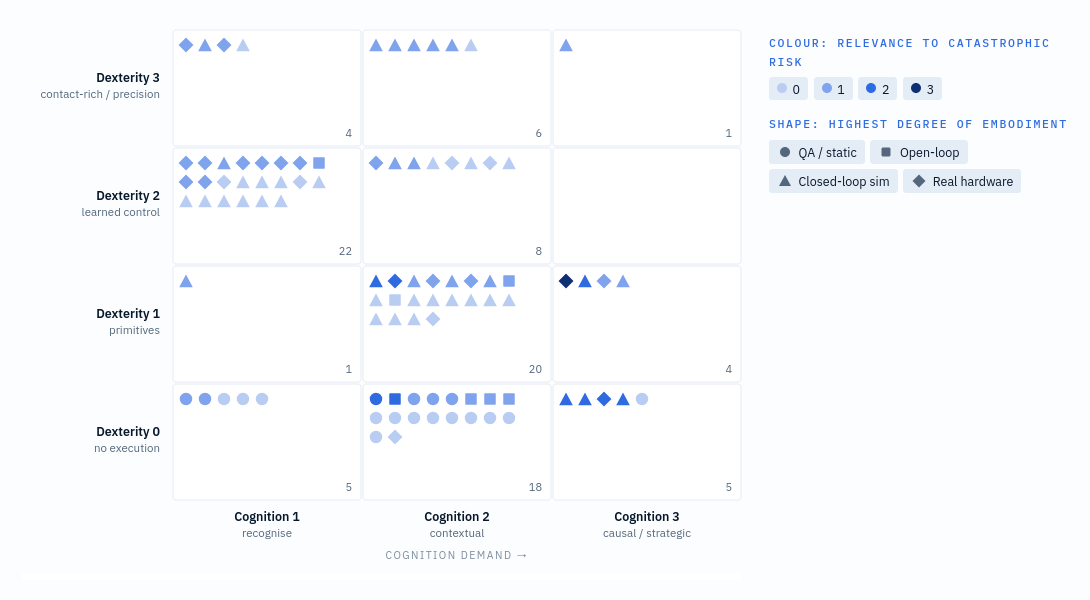
We surveyed 94 published safety evaluations for robots and embodied AI systems and scored each for task complexity, dexterity, cognition and relevance to catastrophic risk. The literature concentrates on everyday physical harm in simulation; no current evaluation combines demanding manipulation with causal or strategic reasoning, and misalignment and loss of control are barely covered. The post sets out nine gaps. The interactive Eval Atlas holds the full catalogue.
Robocurve’s RoboHarm benchmark showed frontier LLM agents carrying out harmful instructions on a real robot. We gave the same models the same instructions in plain text, and then with the robot’s own camera image. They refused. Preliminary results from a small run, and what they do and do not tell us about whether safety training transfers from conversation to physical AI.